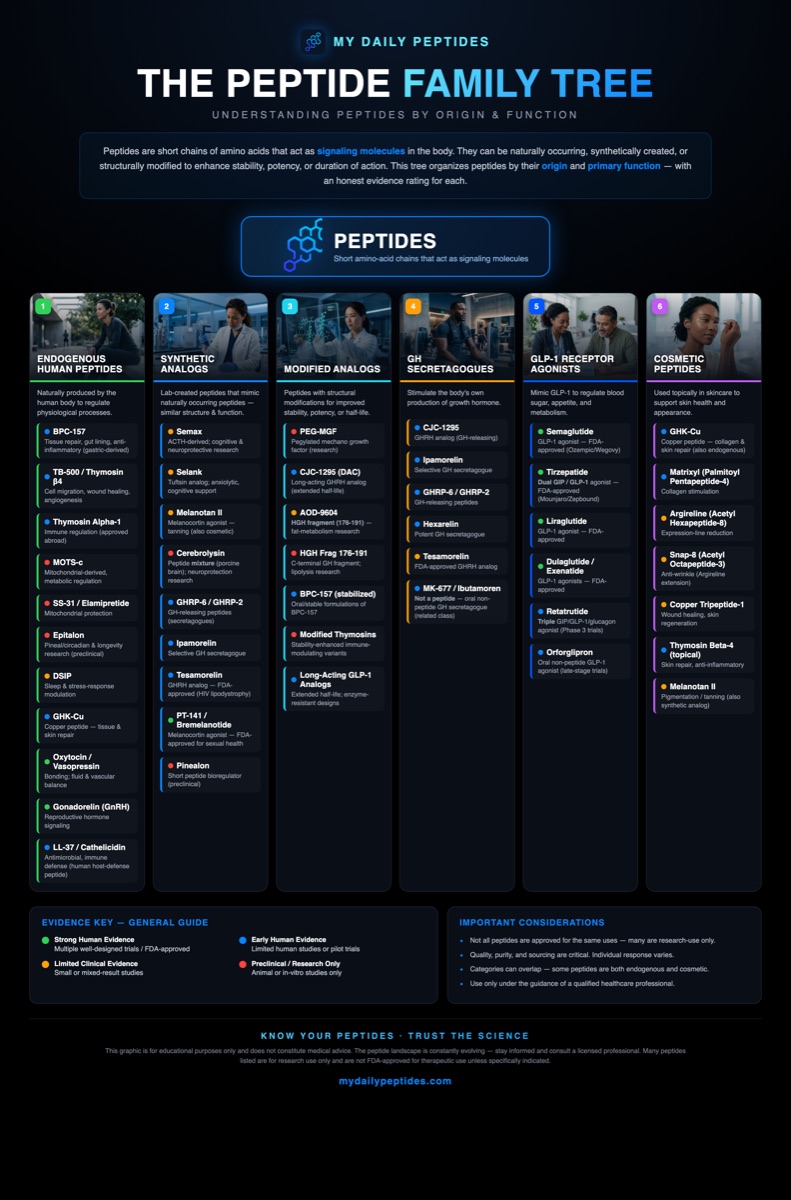
A clear map of the six families of peptides — endogenous, synthetic, modified, GH secretagogues, GLP-1 agonists, and cosmetic — organized by origin and function, with an honest evidence rating for every one.
The Peptide Family Tree: 6 Families of Peptides Explained

If you have spent any time researching peptides, you have run into the alphabet soup: BPC-157, GLP-1, GHK-Cu, CJC-1295, TB-500, MK-677. It is easy to feel like every peptide is either a miracle or a mystery — and the internet rarely helps, blurring the line between what is FDA-approved and what is still confined to a petri dish.
So we built a map. The Peptide Family Tree organizes the most talked-about peptides into six families, grouped by two simple questions: where does it come from, and what does it actually do? Just as importantly, every entry carries an honest evidence rating — because “popular” and “proven” are not the same thing.
Why Organize Peptides at All?
Peptides are short chains of amino acids — the same building blocks that make up proteins, just far smaller. In the body they act as signaling molecules: tiny messengers that tell cells to repair tissue, release a hormone, calm inflammation, or build collagen. Because that job description is so broad, “peptides” as a category is almost uselessly large. A copper skincare peptide and a weight-loss injection are both technically peptides, but they belong in completely different conversations.
Grouping them by origin and function turns that chaos into something you can reason about. It tells you how a peptide was made, how well it is studied, and whether it is a prescription therapy, a research compound, or a cosmetic ingredient.
The Six Families
1. Endogenous Human Peptides
These are produced naturally by your own body to regulate everyday physiology. This family includes some of the most discussed recovery and longevity peptides: BPC-157 (a gastric-derived peptide studied for tissue and gut repair), TB-500 / Thymosin β4 (wound healing and cell migration), Thymosin Alpha-1 (immune regulation), GHK-Cu (a copper peptide for tissue and skin repair), and hormone-signaling peptides like oxytocin and gonadorelin. It also includes LL-37, a human antimicrobial “host-defense” peptide — a detail worth flagging, because LL-37 is genuinely endogenous, not synthetic. Evidence here ranges widely: oxytocin and gonadorelin are well-established, while MOTS-c and epitalon remain largely preclinical.
2. Synthetic Analogs
Lab-created peptides designed to mimic a naturally occurring molecule. Examples include Semax and Selank (Russian-developed peptides studied for cognition and anxiety), PT-141 / Bremelanotide (a melanocortin agonist that is actually FDA-approved for sexual health), and growth-hormone-releasing peptides like GHRP-6 and Ipamorelin. One important nuance: Cerebrolysin is often lumped in here as a single peptide, but it is really a mixture of peptides and amino acids derived from porcine brain tissue — not one clean molecule.
3. Modified Analogs
These start from a known peptide and add structural tweaks to improve stability, potency, or how long they last in the body. CJC-1295 (DAC) is a long-acting GHRH analog engineered for an extended half-life. AOD-9604 is frequently mislabeled — it is specifically a fragment of human growth hormone (the 176-191 region) studied for fat metabolism, not a generic “synthetic peptide.” This family also includes pegylated peptides like PEG-MGF and stabilized, oral-friendly formulations of BPC-157.
4. Growth Hormone Secretagogues
Rather than supplying growth hormone directly, these stimulate your body to release its own. The family includes Ipamorelin, CJC-1295, GHRP-2 / GHRP-6, Hexarelin, and Tesamorelin (an FDA-approved GHRH analog). One frequent point of confusion: MK-677 (Ibutamoren) is often grouped here, but it is not a peptide at all — it is an orally active, non-peptide GH secretagogue. We include it because it belongs to the same functional conversation, but the distinction matters.
5. GLP-1 Receptor Agonists
The most famous family of the moment. These mimic the GLP-1 hormone to regulate blood sugar, appetite, and metabolism. Semaglutide (Ozempic/Wegovy) and liraglutide are established, FDA-approved therapies. Tirzepatide (Mounjaro/Zepbound) is a step further — a dual GIP/GLP-1 agonist. On the horizon, Retatrutide is a triple agonist (GIP/GLP-1/glucagon) in Phase 3 trials, and Orforglipron is an oral, non-peptide GLP-1 agonist in late-stage development. This is the best-evidenced family on the tree.
6. Cosmetic Peptides
Applied topically in skincare rather than injected. GHK-Cu appears here as well as in the endogenous family (it is both) — a copper peptide prized for collagen support. Others include Matrixyl (Palmitoyl Pentapeptide-4), Argireline (Acetyl Hexapeptide-8) for expression lines, and Copper Tripeptide-1. Evidence for cosmetic peptides is mostly limited to smaller studies, but formulation and concentration matter enormously.
Reading the Evidence Ratings
The most important part of the family tree is not the names — it is the color-coded evidence key. We rate every peptide on a four-tier scale:
- Strong human evidence — multiple well-designed trials, often FDA-approved (e.g., semaglutide, PT-141).
- Early human evidence — limited human studies or pilot trials (e.g., BPC-157, CJC-1295).
- Limited clinical evidence — small or mixed-result studies (e.g., Argireline, DSIP).
- Preclinical / research only — animal or in-vitro data only (e.g., MOTS-c, epitalon, PEG-MGF).
This is where a lot of online peptide content falls apart. A peptide can be wildly popular in biohacking circles and still sit firmly in the “preclinical” tier. Knowing the difference is the whole point.
A Few Honest Caveats
Categories overlap. Some peptides are both endogenous and cosmetic (GHK-Cu), or appear as both a synthetic analog and a cosmetic ingredient (Melanotan II). Many peptides on this tree are research-use only and are not approved for the uses people discuss online. And with peptides sourced from a largely unregulated gray market, quality, purity, and sourcing are as important as the molecule itself.
Use the family tree as a map, not a menu. It is designed to help you understand the landscape and ask better questions — not to replace the guidance of a qualified healthcare professional.


Ready to Start Your Peptide Journey?
Finding a qualified provider is the most important first step. Gatlan connects you with licensed telehealth professionals who specialize in peptide therapy — so you can get expert guidance, proper protocols, and pharmaceutical-grade peptides prescribed safely.
This article is for informational purposes only and does not constitute medical advice. Consult a qualified healthcare professional before starting any peptide therapy or skincare regimen.
Frequently Asked Questions
What are the main categories of peptides?
Peptides can be grouped into six functional families: endogenous human peptides (made by the body), synthetic analogs (lab-created mimics), modified analogs (engineered for stability), growth hormone secretagogues, GLP-1 receptor agonists, and cosmetic peptides used in skincare. Grouping by origin and function makes the crowded peptide landscape easier to understand.
Is MK-677 a peptide?
No. MK-677 (Ibutamoren) is often grouped with growth hormone peptides because it stimulates GH release, but it is not a peptide — it is an orally active, non-peptide growth hormone secretagogue. It belongs to the same functional conversation as peptides like Ipamorelin, but structurally it is a different class of compound.
Which peptides have the strongest scientific evidence?
The GLP-1 receptor agonist family has the strongest evidence, with FDA-approved therapies like semaglutide, tirzepatide, and liraglutide backed by large clinical trials. PT-141 and tesamorelin are also FDA-approved. Many popular recovery peptides, by contrast, have only early human or preclinical evidence despite widespread online enthusiasm.
Are all peptides FDA-approved?
No. Only a minority of peptides are FDA-approved for specific uses — such as semaglutide, tirzepatide, PT-141, and tesamorelin. Many peptides discussed online are research-use only and are not approved for the applications people describe. Sourcing, purity, and professional medical guidance are essential given the largely unregulated gray market.
Want to go deeper on specific families? Explore our guides on beauty and cosmetic peptides, the science of oral peptide delivery, and tracking body composition on GLP-1 protocols. For the endogenous recovery side, see our deep dive on KPV and gut inflammation. And if you are weighing where to source, our guide to the peptide gray market is essential reading.
Latest News